

When our primate ancestors emerged from the forest into the savannah about 6-7 million years ago, they had neither rifles nor armor. Facing them were the enormous, terrifying predators that were the ancestors of today’s lions and tigers. Now imagine… It’s pitch black at night, not a sound is heard, and you’re dozing in a tree or at the mouth of a cave. Your visibility is zero. But you hear a rustling sound. At that very moment, that tiny region in your brain called the amygdala goes off the alarm. Your adrenal glands rapidly release adrenaline. Why? Because you have to survive!
The Prehistoric Roots of the Concept of Satan
The human brain dislikes uncertainty in nature. Our amygdalas evolved over hundreds of thousands of years in the African savannas to be “overactive” in order to protect us. While assuming the sound in the example above is wind might seem rational, it’s evolutionarily foolish. Because if it’s a saber-toothed tiger instead of wind, you’ll die. But if you assume there’s something dangerous and run away, you’ll only lose a few calories at most.
In this pre-mythological stage, darkness is a realm of utter helplessness for us. The taxonomic characteristics of nocturnal predators (glowing eyes, sharp teeth, claws, growls, etc.) are ingrained in our collective subconscious as a signal of danger/enemy. Now think about it and picture the depictions of Satan in your mind: horns, hooves, tail, wings… Aren’t they all a “patchwork” of our ancient fears?
Another step in the construction of the concept of “evil/Satan” is the unpredictable, destructive power of nature. In the animistic thought system of the Paleolithic Age, people believed that every object, every phenomenon, and every geographical element in nature possessed a spirit or life energy (anima). However, painful experiences learned through trial and error indicated that not all of these spirits were friendly or benevolent to humans. Devastating earthquakes, floods, droughts, sudden lightning strikes, and inexplicable diseases that most often left humanity helpless were perceived not as meaningless and random natural disasters, but as attacks by conscious, angry, and destructive forces. In a primitive world where germ theory, virology, or genetics were unknown, the sudden fever and death of a perfectly healthy and strong tribal member, or the inexplicable death of newborn babies without any visible injuries, could only be rationalized as a deliberate attack by malevolent, invisible entities. From an anthropological and cognitive perspective, the earliest evil spirits and proto-demon figures produced by the human mind were not intellectual or moral tempters seeking to lead people astray, but rather disembodied forms of directly pathogenic, deadly, and destructive forces of nature.
As the small, nomadic hunter-gatherer groups of the Paleolithic Age grew into the large, settled agricultural societies of the Neolithic Age, the direction and nature of humanity’s struggle for survival began to change. The primal struggle against the harsh elements of nature and ferocious predators was replaced by interpersonal struggles and competition for resources within increasingly complex, hierarchical social structures. It was at this historical juncture that othering and scapegoating came into play. For a society to maintain internal solidarity, cooperation, and social harmony, it often needs an external enemy, conceived as a potential threat. This dual tendency, known in evolutionary psychology as in-group favoritism and out-group derogation, led to the direct stigmatization of foreign tribes, those speaking different languages, those with different physical characteristics, or those practicing unusual rituals as dangerous, unclean, and evil. Outsiders were seen as cursed beings carrying an invisible contagion that would disrupt the existing moral and spiritual order of society.
In the sociological evolution of evil and Satan, this systematic demonization of the “other” represents a crucial turning point in the concept’s development. Humans, in order to survive in a civilized society, suppressed antisocial impulses inherent in their nature—such as aggression, selfish greed, betrayal, and sexual deviance (which perfectly aligns with Carl Gustav Jung’s concept of the Shadow archetype)—by projecting them onto an external enemy or an invisible, omnipresent malevolent metaphysical entity. Through this psychological whitewashing process, the illusion of moral purity, virtue, and innocence within the tribe or society was preserved, while all crimes, diseases, and evils in the world were attributed to an external, alien, and demonic source.
As societies grew larger, and organized states, complex trade networks, written laws, and rigid theocratic hierarchies emerged, the concept of evil became increasingly abstract and intellectualized, paralleling the complexity of this social evolution. The primal evil, once perceived only as a tangible element, has now taken the form of conscious action that disrupts social order, rebels against laws, breaks taboos, and defies authority. Breaking tribal rules, incest, murder, theft, perjury, or disobedience to a spiritual leader came to be seen as a cause of universal catastrophe, incurring the wrath of the gods. A direct causal link was established between the violation of social laws and natural disasters. It was considered certain that one member of the tribe breaking a moral taboo would attract evil spirits that would bring relentless diseases, drought, or swarms of locusts upon the entire village. This paradigm shift fundamentally altered the characteristics of the proto-devil figure that had been taking shape for millennia. This dark entity has now risen to the position of a highly intelligent tempter who infiltrates the human mind, twists its will, and encourages it to break rules, rebel against divine order, and destroy sacred taboos. With the agricultural revolution and the development of architecture, in walled, settled societies where physical survival was relatively more guaranteed, humanity’s greatest shared fear was no longer tigers or wolves howling outside, but moral anarchy and social decay that would collapse the order within.
The Transformation of Pagan Aesthetics into Christianity
Throughout history, the acceptance of a new religious paradigm by the masses has been possible not through the complete destruction of old habits, visual symbols, and narratives, but through their transformation and recontextualization within a new semantic framework. When early Christianity encountered the polytheistic and incredibly rich visual culture of the Roman Empire, the greatest challenge facing missionaries was more visual than theological. People could not suddenly abandon the images of gods they had worshipped for centuries, carved in marble and depicted in mosaics. At this point, Christian theologians and artists used the aesthetics of the old world as a “Trojan Horse” to convey the messages of the new religion.
For example, Helios, or Sol Invictus in its later Roman adaptation, one of the most powerful figures in the pagan world, was the absolute representative of cosmic order, justice, and enlightenment. The iconic rays of light surrounding the sun god’s head were the clearest indication of divinity for the people of antiquity. The biblical depiction of Jesus as “I am the light of the world” (Ego sum lux mundi) perfectly aligns with this pagan iconography. In early Christian art, Jesus was depicted in a sun chariot, much like Sol Invictus. The rays of light above his head evolved into the “halo” concept we see in all depictions of saints today. Similarly, the figure of Hermes, the protector of fertility, flocks, and paths, carrying a lamb on his shoulder, became the direct prototype of the “good shepherd” (Jesus) image.
However, while this visual and cultural heritage was inherited, not only the sacred and good were copied. To define its own absolute good, the new religion needed an absolute evil at least as powerful, terrifying, and tangible as itself. Deeply influenced by the cosmic dualism (the eternal battle between good and evil) between Ahura Mazda and Ahriman in Zoroastrianism, Middle Eastern monotheism had to transform the figure of Satan from an abstract concept into a physical form. Moreover, this form had to be a synthesis of all the elements of the old world that were considered dangerous, wild, uncontrollable, and uncivilized. Thus, the visual evolution of Satan began with the systematic demonization of the gods of darkness and the wild, in stark contrast to this tableau where the gods of light were glorified. By the end of antiquity, the joyful, sensual, and nature-integrated figures of the old religions would be coded as the greatest threats to the newly established moral order and banished to the underworld, to the fires of hell.
The Demonization of Nature
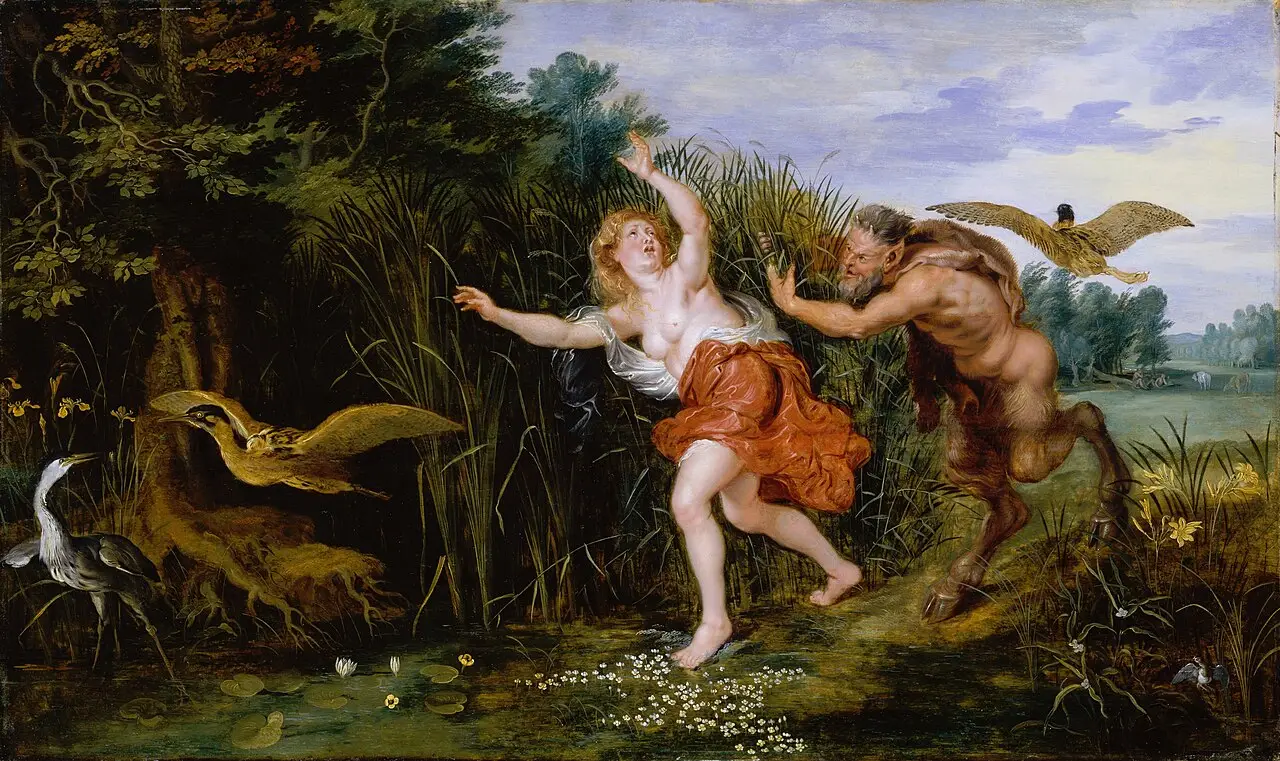
The depiction of Satan in modern popular culture—horned, hoofed, with a goatee and hairy legs—is largely a legacy of Pan, the ancient Greek god of the countryside and forests. Pan was the god of shepherds and flocks, roaming the rugged mountains and untouched forests of Arcadia. He was a symbol of the untamed power of nature, wild energy, and an existence independent of the rules of civilization. This figure, who hated being awakened at midday and whose screams echoed through the mountains when he was angry, causing panic among people, did not necessarily represent absolute evil. However, Pan’s most prominent characteristics—his excessive sexual appetite, his close relationship with Dionysus, the god of wine and ecstasy, and his disregard for rules—were unacceptable to the ascetic Christian morality that viewed bodily pleasures as the greatest obstacle to the salvation of the soul.
The Church Fathers began to define forests and desolate nature as eerie places where the light of God did not reach and where demons roamed. This demonization of nature was, in fact, an attempt by humanity to exclude the dark side within itself. While Pan’s hooves and horns symbolized humanity’s carnal/animalistic nature, in Christian iconography these features became the clearest visual evidence of spiritual decline and alienation from the image of God (Imago Dei). This god, who once danced in the fields playing the flute and embraced all aspects of nature (the word Pan means “whole”), was now transformed into Satan himself, the sum total of all evil and perversion.
This transformation and the motif of demonizing nature is not a phenomenon unique to the ontological crises of Western civilization. For example, in the ancient belief systems of Central Asia and Anatolia, with their animistic and shamanic origins, there is a rich body of demonological literature concerning uncanny geographies and dark entities. Just as Pan, the symbol of wildness and chaos in Greek mythology, was assimilated into a horned and hoofed Devil figure in Christian epistemology, the unknown entities in Turkic-Altaic and Anatolian mythologies represent the unpredictable and deadly face of nature, beyond human rationalization.
In Central Asian animism and shamanic ontology, every element, such as mountains, water, and forests, has a guardian spirit. These mythological beings were initially neutral or dual-natured. They could bring abundance if respected, and disaster if disrespected. However, the transition of societies to settled life and the influence of Abrahamic religions brought about the demonization of some nature spirits. For example, Arçura, the guardian spirit of the forests in early times, and Elbis, the god of war and cruelty, lost their benevolent qualities and transformed into demonic entities in some Turkic communities influenced by Abrahamic religions.
Medieval Paranoia
By the Middle Ages, the figure of Satan had permeated every aspect of daily life and become fully institutionalized. The Church’s efforts to consolidate its absolute power, combined with the famines, plagues, and endless wars of the feudal era, created a need for a “scapegoat” to explain societal traumas. This transformed Satan from an invisible spirit into a leader with armies (witches, sorcerers, heretics) on Earth. The Papacy and the Inquisition courts, taking the Augustinian thought that divided the world into God’s city and Satan’s city to an extreme level of paranoia, systematically criminalized the concept of evil.
The most striking development of this period was the direct labeling of old pagan customs, folk medicine, and esoteric knowledge as Satan worship. Women, especially those who lived in close contact with nature and understood the language of plants, became the primary targets of this institutionalized darkness. For centuries, aromatic resins and herbal incense such as sage and wormwood, used for spiritual purification, protection from disease, or meditative purposes, were suddenly deemed instruments of crime in rituals to summon demonic entities. The pungent smoke and mystical scents of these herbs, once burned for healing and well-being, were recorded by Inquisition judges as concrete evidence of secret pacts with the dark lord. That ancient, esoteric connection between nature and humanity was brutally punished under the guise of witchcraft within the dogmatic walls of the church. Guidebooks like the Malleus Maleficarum formed a dark corpus detailing how to identify and destroy Satan’s agents in human form, down to the finest, most morbid detail.
During this process, Satan’s aesthetic also underwent a transformation. Gargoyles placed atop Gothic cathedrals and frescoes of hell adorning church walls presented Satan’s wrath to the illiterate public through a visual pornography of horror. All human psychological struggles, such as pride, envy, anger, and melancholy, were now considered the whispers of demons. Depression or melancholy was a sign that the soul had fallen under the influence of Satan. The medieval Inquisition, by externalizing evil, maximized its control over society, thereby eliminating the possibility of confronting one’s own darkness for centuries. People now feared a horned monster that might creep down the chimney in the dead of night, rather than their own malevolent impulses.
Modernity and the Devil: From Lucifer to Jung’s Shadow
With the Enlightenment winds of the Renaissance and the subsequent Age of Reason, the figure of Satan as a tangible monster, a hoofed demon, gradually began to lose its power. However, this did not mean that Satan had disappeared. Satan merely changed form, retreating into the depths of philosophy, literature, and ultimately, psychology.
Lucifer, as depicted in John Milton’s epic poem “Paradise Lost,” is a tragic hero—highly charismatic, intellectual, and willing to risk everything for his free will—who prefers to “rule in hell rather than serve in heaven.” Mephistopheles in Goethe’s “Faust,” on the other hand, is a sophisticated intellectual who mocks the limits of human reason, values knowledge and intelligence, and reflects the insatiable dissatisfaction of modern man.
In the 20th century, Carl Gustav Jung, one of the founders of psychoanalysis, moved the concept of Satan entirely to a psychological level, explaining him through the archetype of the “Shadow.” According to Jung, the Shadow is the sum of the dark aspects of our self that we reject, repress, are ashamed of, and find unacceptable to society. Because we cannot accept this darkness within ourselves, we ostracize it, creating a figure of Satan and projecting it onto him (projection).


